Atmospheres of Hot Rocky Planets with Ultra-Short Orbital Period

Atmospheres of Hot Rocky Planets with Ultra-Short Orbital Period

Back to Research

Rocky exoplanets with ultra-short orbital periods are ideal targets for observations and offer a unique opportunity to study planets in extremely hot environments. Due to atmospheric escape, these planets are more likely to be airless like Mercury or to have a secondary atmosphere (non-hydrogen dominated) like Earth. Characterizing secondary atmospheres of such exoplanets provides crucial insights into atmospheric escape, redox and equilibrium chemistry, and exchange with the interior.

Orbital periods and radii of confirmed exoplanets as of May 2025. The planets located in the red box are rocky exoplanets with ultra-short orbital periods. The color of each point represents the equilibrium temperature of the planet, ranging from 500 to 3,000 K.

Orbital periods and radii of confirmed exoplanets as of May 2025. The planets located in the red box are rocky exoplanets with ultra-short orbital periods. The color of each point represents the equilibrium temperature of the planet, ranging from 500 to 3,000 K.

Despite extensive observations, most current interpretations predominantly relied on 1D models with non-self-consistent heat redistribution or oversimplified 3D models with unrealistic radiative transfer. However, few 3D models with realistic radiative transfer have been applied to these hot (non-habitable) rocky exoplanets, mainly due to the incompatibility of standard GCM radiative transfer codes with the extremely high temperatures.

Gaussian and Lorentz profiles for absorption line broadening calculations. The coefficients of determination αG (half-width at half-maximum) and αL strongly depend on temperature (highlighted in red). More information on HITRAN.

Gaussian and Lorentz profiles for absorption line broadening calculations. The coefficients of determination αG (half-width at half-maximum) and αL strongly depend on temperature (highlighted in red). More information on HITRAN.

Modeling Pipeline

Realistic radiation for extreme rocky atmospheres.

To model hot rocky planets self-consistently, we build a non-grey GCM framework that can operate at temperatures far above those usually assumed in terrestrial climate models. The pipeline builds opacity tables from high-temperature molecular line lists, validates correlated-k coefficients against line-by-line calculations, and couples the results to three-dimensional general circulation models.

First, we use high-temperature molecular line lists from the ExoMol database. With ExoCross, we calculate absorption cross sections over the pressure-temperature range relevant for hot secondary atmospheres, including conditions expected on lava worlds.

Second, we convert these cross sections into custom correlated-k coefficients. The correlated-k method compresses line-by-line opacity information into a form that can be used efficiently inside a GCM while retaining realistic spectral behavior. We validate the resulting coefficients against line-by-line radiative-transfer calculations with PyRADS.

Finally, we run three-dimensional simulations with Isca coupled to SOCRATES. This setup allows us to predict circulation, day-night heat transport, thermal emission, and phase-curve behavior for hot rocky planets with thin secondary atmospheres.

The schematic of the pipeline of this work. The gas absorption in our model includes molecular spectrum (including UV absorption) and collision induced absorption (CIA).

The schematic of the pipeline of this work. The gas absorption in our model includes molecular spectrum (including UV absorption) and collision induced absorption (CIA).

Case Study: Utilizing 3D GCMs to Reinterpret JWST Observations of 55 Cancri e

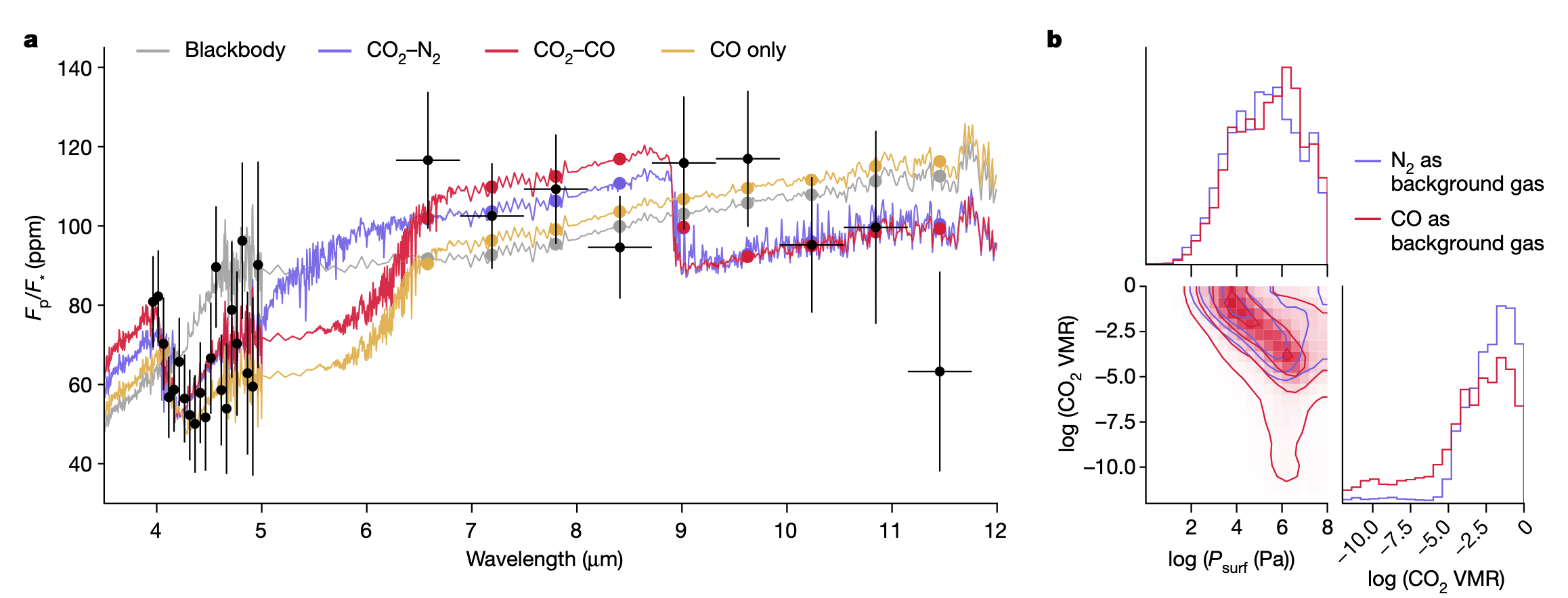
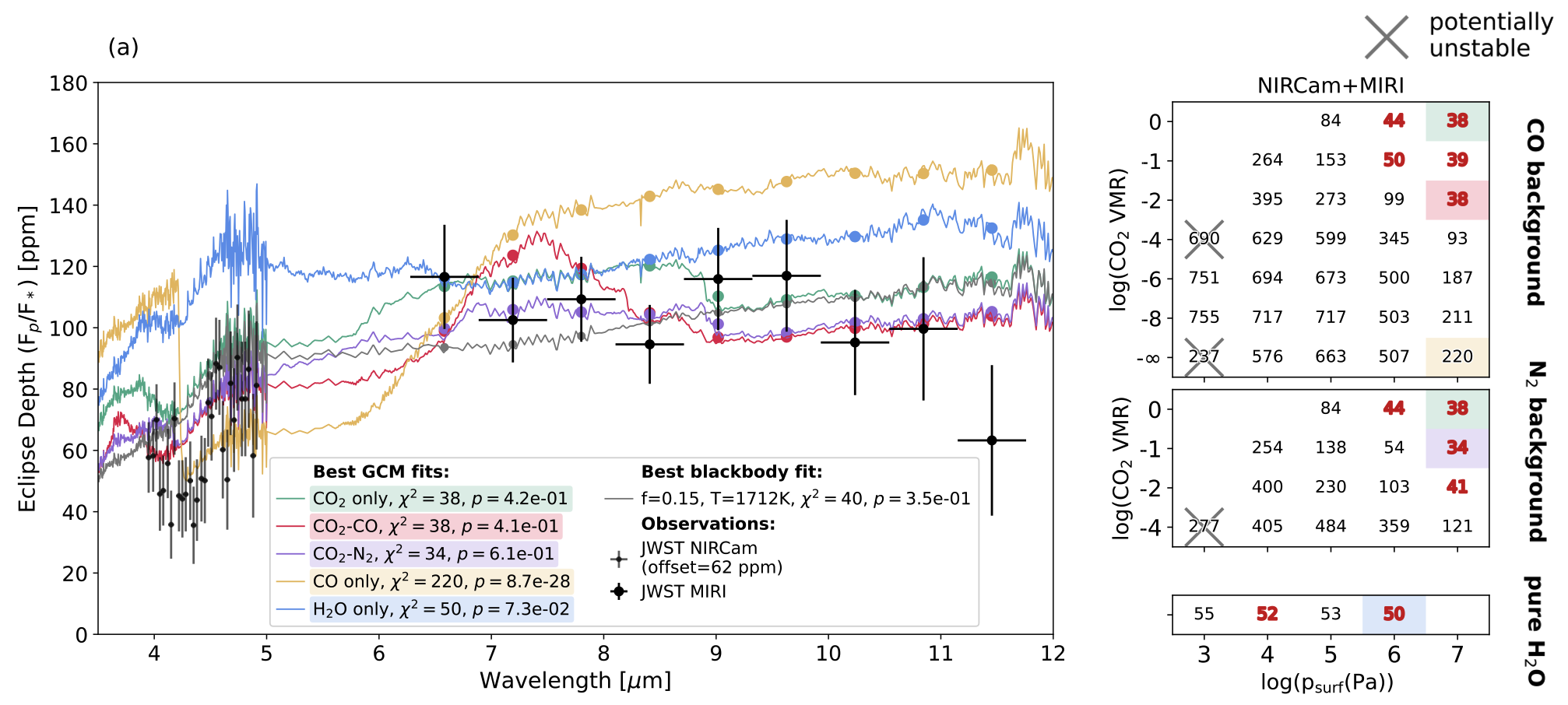
We apply this framework to reinterpret JWST observations of 55 Cancri e, including the thermal-emission constraints reported by Hu et al. 2024. The goal is to test whether realistic three-dimensional circulation, non-grey radiative transfer, and thin secondary atmospheres can change how we infer atmospheric survival from thermal-emission observations.

Interesting Science to Be Continued

Beyond a single planet, this framework connects directly to current observing efforts such as the JWST Rocky Worlds DDT program. Observations can tell us whether a planet has an atmosphere today, while evolution models are needed to understand how that atmosphere formed, changed, or disappeared over time. The next questions are how escape, chemistry, circulation, magma-atmosphere exchange, and interior evolution jointly shape the observable diversity of hot rocky exoplanets.

docs